

Key Takeaways
The Illusion of Novelty
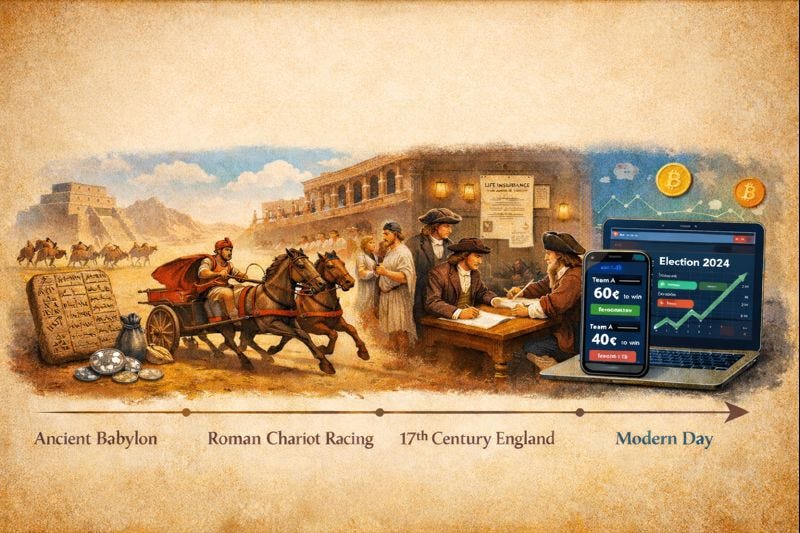
Modern “prediction markets” are marketed as a revolutionary asset class, but the underlying mechanism is thousands of years old.
The tech narrative frames these platforms as information tools, yet their core function mirrors ancient wagering.
Babylonian Bottomry: Productive Risk Sharing
Ancient bottomry loans tied repayment to the success of a voyage, blending financing with risk transfer.
The key distinction: skin in the game–lenders’ money enabled real economic activity, not synthetic speculation.
England’s Life Insurance Mania: When Risk Turns Toxic
In the 17th–18th centuries, life insurance morphed into gambling as people bought policies on strangers, celebrities, even the king.
This created moral hazard and public outrage, leading to the 1774 Life Assurance Act and the doctrine of insurable interest.
Modern Platforms: A Tech Gloss on Old Gambling
Platforms like Kalshi and Polymarket present themselves as financial hedging tools, but 80–90% of volume on Kalshi is sports betting. It’s less on Polymarket, but they are just entering the U.S. market.
The industry uses regulatory arbitrage—branding wagers as “event contracts” to avoid gambling classifications.
The 1%?
Brian Armstrong, CEO of Coinbase, stated that only 1% trades the contract, 99% use it for informational purposes.
If the price of a contract provides the information for free, anyone who buys the contract is not seeking information—they’re betting (mostly). If Brian Armstrong is instead suggesting that, for every trader on the platform, there are 99 people outside who just consume the information, that claim is wildly exaggerated and entirely unsubstantiated.
Today’s markets replicate the same synthetic risk patterns that historically led to speculative excesses, backlash and regulatory intervention.